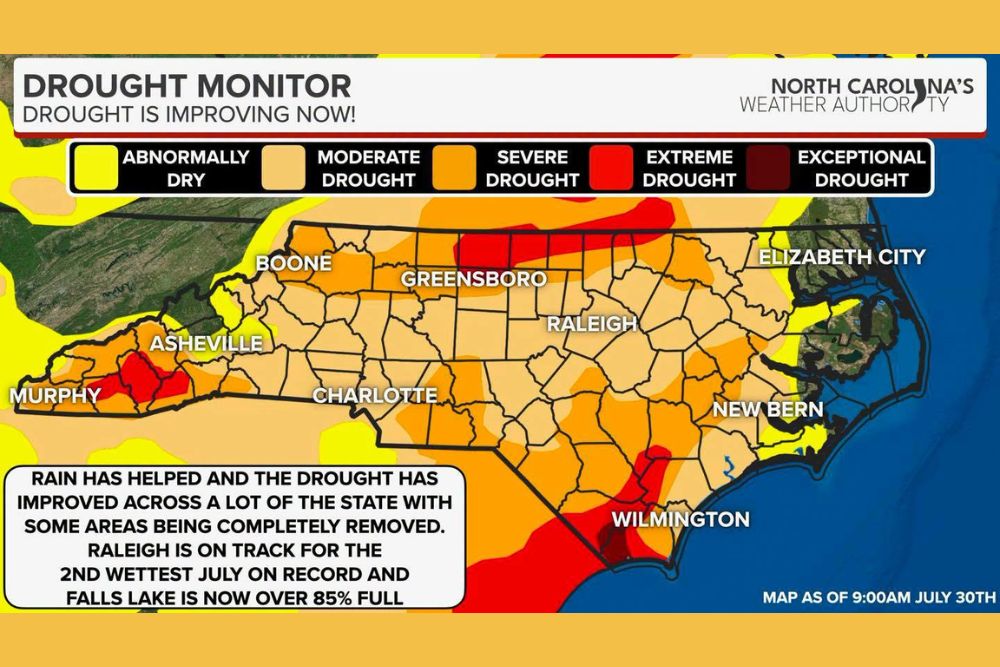
NORTH CAROLINA — Recent on-and-off heavy rainfall has led to significant improvements in drought conditions across most of North Carolina, with nearly all areas except southeastern North Carolina seeing reductions in drought categories. The biggest improvements have occurred across central and eastern portions of the state, moving from extreme drought to moderate drought conditions. Parts of northeastern North Carolina, including the Inner and Outer Banks, now have no drought at all.
Central and Eastern Regions See the Sharpest Improvement
The most significant drought improvement has occurred across central and eastern North Carolina, where conditions have shifted from extreme drought down to moderate drought following recent rounds of heavy rainfall.
Communities in this corridor, including areas surrounding Raleigh and Greensboro, have benefited most directly from the recent precipitation, marking a substantial step down in drought severity compared to conditions just weeks ago.
Falls Lake Rises Nearly 3 Feet and Tops 85 Percent Full
Falls Lake has risen almost 3 feet as a direct result of the recent rainfall and is now over 85 percent full, reflecting one of the clearest tangible signs of drought recovery in the Raleigh area.
This improvement in reservoir levels has translated into real-world benefits, with Raleigh Water lifting water restrictions as a direct consequence of the lake’s substantial recovery over the past couple of weeks.
Raleigh Tracking Toward Second Wettest July on Record
Raleigh is on track for its second-wettest July on record, with 12.16 inches of rain having fallen in the city so far this month, a remarkable total contributing directly to the region’s drought recovery.
This exceptional monthly rainfall total underscores just how significant the recent wet pattern has been, providing a meaningful boost to water supplies and soil moisture across the greater Raleigh area.
Northeast North Carolina and Outer Banks See Drought Eliminated
Parts of northeastern North Carolina, including areas near the Inner and Outer Banks and Elizabeth City, have seen drought conditions completely eliminated following the recent stretch of beneficial rainfall.
This complete removal of drought designation represents the best possible outcome for these areas, standing in contrast to other parts of the state that still show lingering, if improved, drought conditions.
Southeastern North Carolina Remains the Exception
Southeastern North Carolina, including areas near Wilmington, stands out as the exception to the broader improvement trend, with this region not seeing the same reductions in drought categories as the rest of the state.
More rain will be needed to fully wipe out the drought across all of North Carolina, though forecasters say the overall direction of improvement across most of the state is an encouraging sign heading into August.